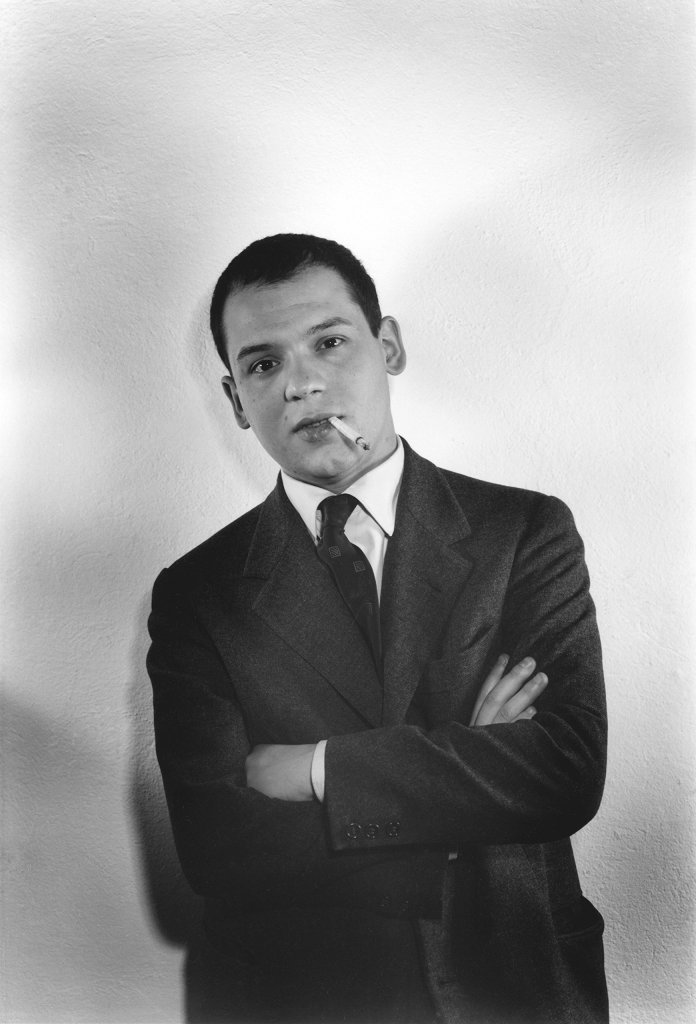
Piero Manzoni was born in Soncino in 1933 and attended the Faculty of Law at Milan’s Università Cattolica del Sacro Cuore without completing his university studies During the second half of the 1950s, after having realised some traditional landscapes, attracted and inspired by the Ligurian landscape of Albissola where he often went on holiday with his family, Manzoni devoted himself to an intense research of experimentation conducted both on a technical-material and aesthetic-conceptual level
The artist initially approached the abstract-informal experiences of Burri, Fontana and Fautrier: he began to frequent the Milanese artistic environment by visiting the studios of the artists Roberto Crippa and Gianni Dova, exponents of the Spatialist Movement
In 1955, he began to produce a series of works by immersing objects in colour and imprinting them on canvas; this was followed by paintings made with tar and, in 1956, he published the manifesto Per la scoperta di una zona di immagini In the same year in Milan, the artist exhibited at the Galleria San Fedele participating in the 1956 San Fedele Painting Prize, the following year at the Galleria Pater in Milan and joined the Gruppo Nucleare co-signing the Manifesto Against Style
From the end of 1957 he produced his first Achromes, white paintings made with canvas soaked in rough chalk, he used felt, cotton wool and expanded polystyrene in 1960, glass wool the following year, bread and stones and other materials in 1962…
The work does not illustrate a specific subject, nor does it refer to anything beyond the frame, it is self-referential: the artist’s aim is to deprive the work of any narrative content, eliminating colour, the only subject of the painting is matter
Having distanced himself from the Nuclear Group, in 1959 he met Castellani, Bonalumi and Agnetti; with Castellani he founded the magazine ‘Azimuth’ and the Milanese gallery of the same name, developing an increasingly conceptual approach and producing his first Lines on rolls of paper which were then rolled up and closed into cylinders on which the artist pasted a label bearing the length, date and his signature
Writings by intellectuals and critics, such as Gillo Dorfles, works by artists such as Fontana, Yves Klein, Jasper Johns and Robert Rauschenberg, as well as poems by Edoardo Sanguineti, Nanni Balestrini and others appear in the magazine Piero Manzoni travelled and exhibited in Holland, Denmark and Germany
He created forty-five Corpi d’aria, common balloons to be inflated and placed on a pedestal and, later, he created Fiati d’artista with which the figure of the artist becomes central: the breath itself becomes creation In 1960, he presented his most famous performance at Azimut: Consuming the public’s dynamic art – Devouring Art, during which he distributed boiled eggs signed with his thumbprint, inviting those present to eat them Towards the end of the year, he signed the Manifesto Against Nothing for the International Exhibition of Nothing signed by Castellani, Mack and Piene, among others He continued to work on the Achromes, using the most disparate materials, and designed the Magic Base, a pedestal that elevated to the role of work of art any person willing to climb onto the pedestal He exhibited with Castellani at the La Tartaruga gallery in Rome, where he presented other Achromes and signed some Sculture viventi: for Manzoni, art had to be total, art had to live
Of the performance Living Sculptures there are many photos documenting the event, in these precious documents Manzoni signs some people, who are then given stickers certifying their being works of art: the red sticker means that the person will be a living sculpture until death, the purple sticker is similar to the red one but for a fee, the yellow one indicates that only a part of the body is a living sculpture, while the green one means that the person will only be a sculpture in certain positions and attitudes
In 1961, he made ninety cans of Artist’s Shit sold by weight at the gold price: the series is a critical reflection on the consumption and commercialisation of art and, more generally, of consumer capitalist society
Starting from the concept that art encompasses the totality of reality and life on earth, Manzoni realised the same year, during a stay in Denmark, the Base of the World, a ‘magic base’ in iron which, as the upside-down engraving on the same base, ‘Socle du monde’, declares, supports the whole world He continued working on the Achromes and in 1962 participated with the Zero group in the exhibition ‘Nul’ at the Stedelijk Museum in Amsterdam
In 1962, the project of searching for universal signs takes a more organic form: Manzoni elaborates 8 tables of ascertainment, in a ‘folder’ format in which sixty numbered copies appear with eight photolithographs published by Vanni Scheiwiller and with a preface by Vincenzo Agnetti
Piero Manzoni died of a heart attack in his Milan studio on 6 February 1963, leaving behind a significant artistic production, which constitutes an essential reference point, especially for conceptual and Arte Povera artists