
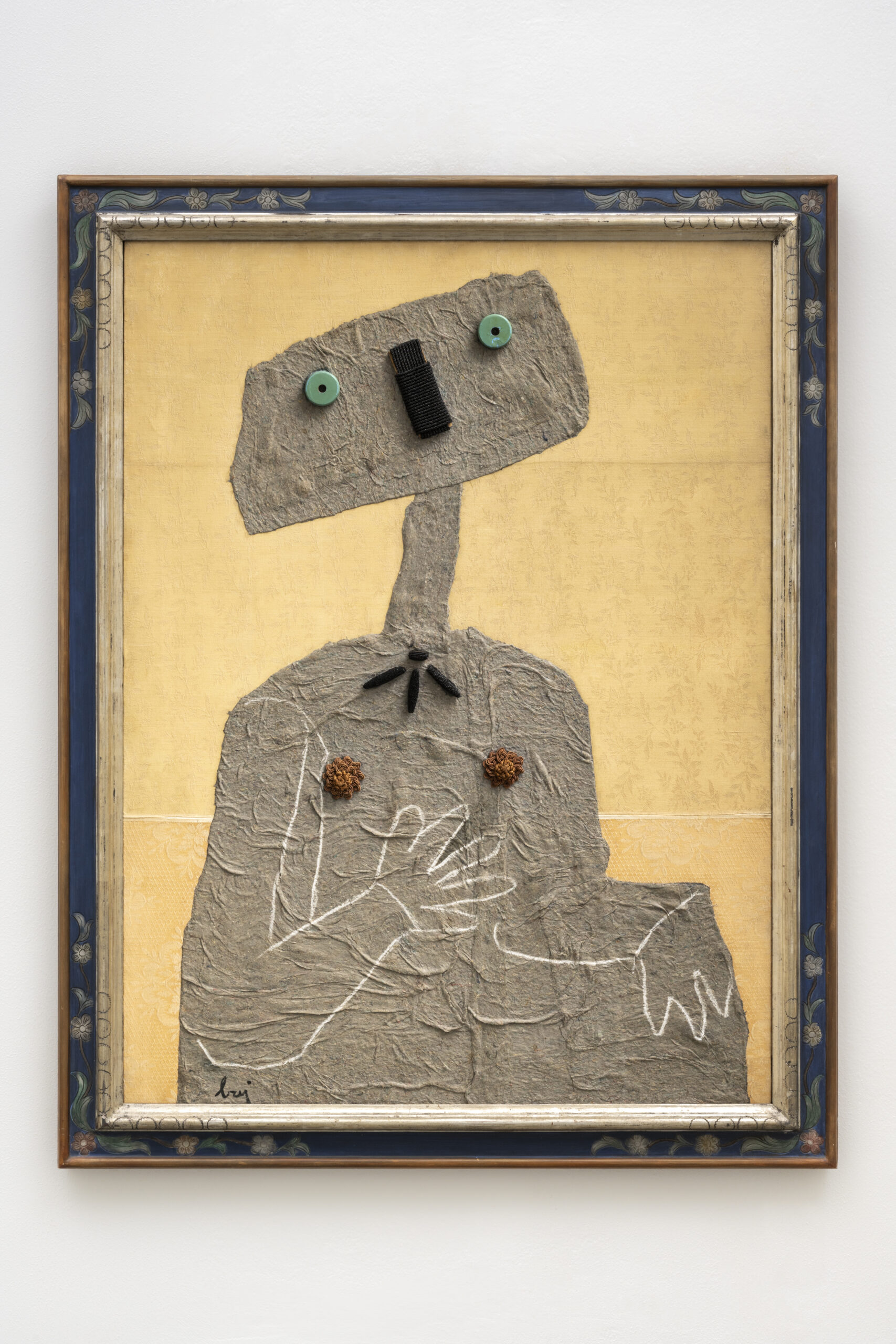
Acrylic on fabric and trimmings on canvas
cm 130 x 97
1966
NOTE: Signed lower left;
PROVENANCE: Galerie Mayer, Brussels; Johannes Wasmuth, Rolandseck; Private collection, Italy.
EXHIBITIONS AND PUBLICATIONS: Klaus Grunewald, Baj, Galerie Mayer, Brussels, 1967, ill. in cat. n. 16; Bolaffi Catalogue of Enrico Baj’s works, edited by Enrico Crispolti, Edizioni Bolaffi, Turin, 1973, ill. in cat. n. 1254.
Discover the video of the artwork (right-click on the link and select “open link in another browser window”) https://youtube.com/shorts/m3zCCX4eglo?feature=share
Today I want to tell you about an artist, Enrico Baj, who was able to tackle very serious— sometimes even very dramatic ones, with the carefree gaze of a child. I experienced this personally because the house where I grew up with my brother Ettore had several works by Baj—since our father worked with the artist—and one in particular always managed to bring a smile of surprise to our little friends’ faces because it was made with Lego bricks. Of course, everyone always thought it was our own creation and even tried to pull off a few bricks—which probably happened. In this work as well, *Femme au fauteuil* (*Woman in an Armchair*), we see that the elements of the face and body are made from objects found around the house, perhaps even toys, like these painted wheels. Here we have a nose made from a spool of thread, nipples made from trim, just as the background is a piece of upholstery fabric; the arm and hand are drawn with chalk, as a child might do on the ground.
His way of playing, just like that of children, is anything but superficial: with his deformed and grotesque figures made from household objects, Baj reveals the violence of the established power structure, the obtuseness of those who idolize positions and roles, and the vanity of social conformity. Through Meccano, he reminds us—as early as fifty years ago—how much our imagination and our uniqueness are at risk in an increasingly automated world. His irreverent irony, a legacy of Surrealism, is always, politically, aimed at demystifying the present and its monsters.